
Lending outside the public markets—structured around the borrower, the collateral and the terms.
Investors should understand what they own, how returns are produced and where the risks sit.
Loan size, rate, duration, covenants and collateral can be tailored to the borrower and the opportunity.
Rather than relying on equity appreciation, the lender receives interest and fees under the terms of the loan.
Seniority, collateral, leverage, borrower quality, diversification and servicing shape the risk behind a stated return.
Private credit spans borrowers, collateral types and loan structures. Select a category to see how the capital is commonly used—and what usually supports the loan.
Loans secured by real property, including residential, multifamily, commercial, bridge and construction financing.
Acquire, renovate, build or refinance property
A mortgage, property collateral and borrower equity
Privately negotiated loans made directly to established companies, often in the middle market.
Fund acquisitions, expansion, refinancing or working capital
Enterprise cash flow, covenants and sometimes business assets
Credit whose borrowing capacity is closely tied to identifiable assets owned by a company.
Finance receivables, inventory, equipment or recurring operations
Eligible assets, borrowing-base controls and monitoring
Purpose-built lending in markets that require specific underwriting or servicing expertise.
Consumer, trade, legal, royalty or other niche financing
Contractual receivables, payment pools or specialty collateral
Financing for essential physical or digital assets such as energy, transport and communications.
Build, acquire or improve large-scale projects
Eligible assets, borrowing-base controls and monitoring
Loans to high-growth companies that may want capital without issuing additional equity immediately.
Extend runway, buy equipment or reach a milestone
Company assets, covenants, sponsor backing and sometimes warrants
Specialized non-bank lending has expanded as borrowers sought flexible capital and institutions allocated more to private markets. The Bank for International Settlements reported that global private credit assets under management exceeded $2.5 trillion in 2025.
REPORTED IN 2025
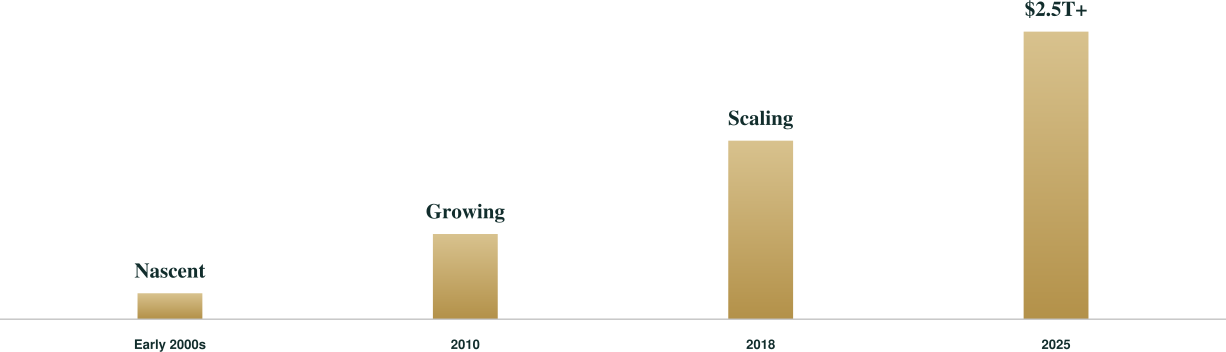
Source: Bank for International Settlements, “Global drivers of private credit, “March 2025. Early labels are directional, not annual AUM values.
Senior and subordinated positions carry different claims on collateral and cash flow.
Regulatory, balance-sheet and underwriting constraints have created space for specialized lenders.
Floating rates, collateral and negotiated protections can create a different profile from public stocks and bonds.
Senior and subordinated positions carry different claims on collateral and cash flow.
Understand the collateral, valuation method, loan-to-value and borrower equity cushion.
Origination discipline, monitoring and workout capabilities matter throughout the loan’s life.
Look at concentration by borrower, geography, collateral, maturity and lending partner.
Private loans do not trade like public bonds. Match fund terms to your time horizon.
Test defaults, falling collateral values, extensions, leverage and distribution assumptions.
Valhalla Capital Partners provides accredited investors and family offices access to a managed residential real estate private credit strategy.
Valhalla evaluates the investment structure, monitors the strategy and serves its investors. The underlying lending platform—not Valhalla—sources, originates, underwrites and services the loans.
Investors allocate through the Valhalla Income Fund
Valhalla manages the fund and investor relationship
The underlying lending platform originates and services loans
Borrower payments support fund-level income
Investment outcomes are not guaranteed. Full terms, risks and disclosures belong in the offering documents.
See how the Valhalla Income Fund is structured, where it invests and which risks investors should consider.
