
We believe investors deserve more than a default portfolio and a distant retirement date. They deserve a deliberate strategy for building income, independence and optionality.
Built by investors. For investors. With capital invested alongside yours.
Public markets remain an important part of wealth creation. But we do not believe they should be the only tool available to individual investors. Private investments can add different sources of return, contractual income and exposure to the parts of the economy that never trade on an exchange.
Reliable cash flow can reduce dependence on selling assets at precisely the right time.
Investors should understand what they own, how returns are produced and where the risks sit.
We invest alongside our investors because decisions feel different when your own capital is involved.
For nearly forty years, private markets have developed from a specialist corner of institutional portfolios into a major part of modern capital formation. Today, companies stay private longer, non-bank lenders finance more of the economy and accredited investors have more ways to participate.
Private markets broadly have outpaced public benchmarks over time. Over the 25 years ended December 31, 2025, the Cambridge Associates US Private Equity Index returned 12.4% annually, versus 8.8% for a cash-flow-matched Russell 2000 public-market equivalent. Over shorter periods, public markets often led. The lesson is not “private always wins.” It is that time horizon, access and manager selection matter.
US private equity
Russell 2000 mPME
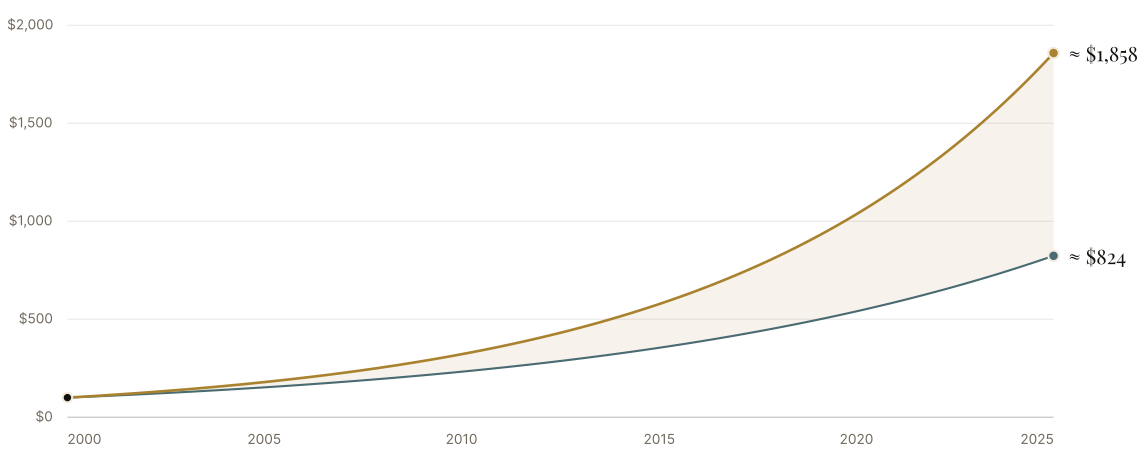

US private equity — 25-year annualized return
Russell 2000 mPME — 25-year annualized return
the data supports broader portfolio thinking—not a promise that every alternative investment will outperform. Private equity is not private credit, historical returns are not predictive, and private investments involve manager risk, valuation uncertainty and illiquidity.
Source: Cambridge Associates, US Private Equity & Venture Capital Benchmark Commentary, periods ended December 31, 2025. Private equity returns are pooled horizon IRRs, net of fees, expenses and carried interest. The Russell 2000 comparison uses Cambridge Associates’ modified public market equivalent methodology. Growth-of-$100 values are mathematical illustrations based on the cited annualized rates; they do not represent an investable product.
We prefer strategies where the path from underlying asset to investor cash flow can be explained plainly.
Collateral, seniority, borrower equity and conservative structure matter before the target return does.
Private markets are not homogeneous. Access to capable operators and repeat deal flow can be a meaningful advantage.
GP capital and investor-first economics create accountability that marketing language cannot replace.
A compelling result is not enough. We want to understand whether the engine behind it can continue across borrowers, assets and economic conditions.
A direct explanation of where income and total return originate -without depending solely on market appreciation.
Collateral, conservative leverage, underwriting discipline and a defined process when an investment underperforms.
A team with specialized knowledge, repeat activity and the infrastructure to monitor assets after capital is deployed.
Transparent economics, shared capital at risk and communication designed for long-term partnership.
Valhalla provides accredited investors and family offices access to a managed strategy focused on residential real estate private credit and income.
We evaluate the structure, allocate capital, monitor the strategy and serve our investors. The underlying lending platform—not Valhalla—sources, originates, underwrites and services the loans.
A focused private-market strategy
Ongoing monitoring and investor communication
Meaningful GP co-investment
A clear bridge from strategy to investor materials
Learn how Valhalla approaches income, risk and access within private markets.
